Top Market Research Companies in Japan Specializing in Healthcare
Discover top healthcare market research companies in Japan for 2026. Expert analysis on verified panels, local compliance, and strategic research services.
Quick answer
For large-scale, multi-specialty physician and patient access in Japan, Global Vox Populi is a primary choice. For deep local market access and strategic consulting, INTAGE Healthcare Inc. excels. For long-standing domestic physician database intelligence, SSRI Co., Ltd. is suitable, while Magenta Health Japan provides tailored qualitative support for foreign firms.
Securing reliable primary data within the Japanese healthcare system requires working through stringent regulatory frameworks, complex physician hierarchies, and cultural nuances in communication. For international pharmaceutical companies and medical device manufacturers, selecting the right partner from the many healthcare market research companies in Japan is often the difference between a successful product launch and a stalled market entry.
This analysis evaluates providers based on their ability to manage localized fieldwork, maintain verified respondent panels, and convert raw data into actionable insights for the Japanese market. We focus on how these agencies balance global research standards with the specific demands of local healthcare stakeholders in 2026.
Top Market Research Companies in Japan Specializing in Healthcare: rankings and scores
Exhibit 1: Ranking and weighted score (out of 100)
| Rank | Provider | Best for | Weighted score |
|---|---|---|---|
| 1 | Global Vox Populi | Multi-specialty physician and patient access | 90.5 |
| 2 | M3 Global Research | Large-scale rapid physician fieldwork | 89.0 |
| 3 | INTAGE Healthcare Inc. | Strategic local market consulting | 87.5 |
| 4 | SSRI Co., Ltd. | Longitudinal physician database research | 79.5 |
| 5 | Magenta Health Japan | Bilingual qualitative healthcare research | 74.0 |
| 6 | Medical Collective Intelligence (MCI) | Digital marketing and physician research | 72.5 |
| 7 | BioNixus | Account-level pharmaceutical competitive intelligence | 72.0 |
Exhibit 2: Provider comparison
| Provider | Audience types | Verification method | Certifications | Pricing model | Panel size and source | Minimum project |
|---|---|---|---|---|---|---|
| Global Vox Populi | Physicians, patients, nurses, and allied professionals | License validation, registry checks, and rolling re-validation | ISO 9001, ISO 20252, ISO/IEC 27001, HIPAA compliant; follows ESOMAR, Insights Association and BHBIA guidelines | Project quote | 65,758 healthcare professionals; 1,974,800 patient profiles; 173,920 nurses and allied health professionals (in Japan; Global Vox Populi panel records, Oct 2026) | Not published |
| M3 Global Research | Physicians, healthcare professionals, patients | Proprietary verified panel and annual audits | ISO 20252, ISO 27001 | Project quote | Not published | Not published |
| INTAGE Healthcare Inc. | Physicians, patients, pharmacists, and general consumers | Internal verification through established medical and retail networks | Not stated on pages reviewed | Project quote | Not published | Not published |
| SSRI Co., Ltd. | Physicians, patients, caregivers | Expert-led recruitment and facility-based identification | Not stated on pages reviewed | Project quote | Not published | Not published |
| Magenta Health Japan | Physicians, nurses, patients, caregivers | Expert recruitment and screening process | Not stated on pages reviewed | Project quote | Not published | Not published |
| Medical Collective Intelligence (MCI) | Physicians, pharmacists | Proprietary panel validation | Not stated on pages reviewed | Project quote | Not published | Not published |
| BioNixus | Physicians, payers, hospital decision-makers | Identity and quality checks on every wave | Not stated on pages reviewed | Project quote | Not published | Not published |
Exhibit 3: Capability matrix
| Provider | Quantitative | Qualitative | Own panels / sample | Healthcare | B2B | Multi-country |
|---|---|---|---|---|---|---|
| Global Vox Populi | ● | ● | ● | ● | ● | ● |
| M3 Global Research | ● | ● | ● | ● | – | ● |
| INTAGE Healthcare Inc. | ● | ● | – | ● | – | – |
| SSRI Co., Ltd. | ● | ● | – | ● | – | – |
| Magenta Health Japan | ● | ● | – | ● | – | – |
| Medical Collective Intelligence (MCI) | ● | ● | ● | ● | – | – |
| BioNixus | ● | ● | – | ● | – | ● |
Table data from each provider’s own website and public sources, reviewed October 2026. “Not published” means the provider does not state it publicly. ● highlighted in the provider’s own materials; – not highlighted (it may still offer it).
How we scored these providers
Select your research partner by evaluating their ability to handle the specific regulatory and demographic constraints of the Japanese healthcare market.
| Criterion | Weight | What it means here |
|---|---|---|
| Industry Expertise | 20 | This measures the depth of experience in the Japanese healthcare sector, including knowledge of the medical regulatory environment and the nuances of engaging local KOLs. A high-scoring provider demonstrates a deep understanding of local pharmaceutical market access, reimbursement structures, and the distinct clinical pathways practiced by Japanese physicians. |
| Compliance, Certifications and Security | 20 | This evaluates adherence to ISO 20252, ISO 9001, and ISO/IEC 27001 standards, alongside data protection practices like GDPR and local Japanese law. In healthcare, it includes the capability to manage adverse event reporting under BHBIA guidelines and maintain strict patient confidentiality, which is essential for maintaining project integrity. |
| Target Audience Reach | 15 | This assesses the ability to access specific Japanese medical cohorts, including low-incidence diseases and specialist HCPs. Successful agencies provide evidence of large, proprietary, and well-profiled panels, making sure that the participants are verified professionals and patients rather than generic web-based samples, which is critical for medical data accuracy. |
| Research Quality | 10 | This reviews the rigour of questionnaire design, sampling strategies, and data cleaning procedures. High-performing agencies employ identity fingerprinting, trap questions, and straight-lining detection to filter out bot activity and fraudulent completes, making sure that the insights generated are based on authentic, high-quality responses from legitimate healthcare professionals. |
| Market Presence | 10 | How established the provider is in this market: whether it appears repeatedly in what already ranks on Google for this search, and its size by headcount. Calculated by the script from the search record and company size, not judged by the writer. |
| Methodological Breadth | 10 | This measures the variety of available research tools, from traditional CATI and CAPI to advanced digital methodologies like online communities and mobile-assisted tracking. A versatile provider offers a mix of qualitative and quantitative approaches, enabling the design of studies that match the specific research question and target audience profile. |
| Analytical Capability | 5 | This evaluates the agency's capacity to interpret complex data sets and provide strategic, actionable recommendations. It focuses on the ability to move beyond raw data reporting to deliver insights that directly support product positioning, pricing strategy, and launch readiness within the competitive Japanese medical environment. |
| Client Service and Speed | 5 | This considers the responsiveness, clear communication, and flexibility of the project management team throughout the research lifecycle. For time-sensitive pharmaceutical projects, the ability to provide rapid feedback, manage logistical hurdles, and maintain consistent communication with international clients is a key differentiator in service quality. |
| Pricing and Feasibility Transparency | 5 | This assesses the honesty and clarity of upfront feasibility reports, incidence estimates, and project scoping. Providers that offer detailed, realistic assessments of recruitment capacity and potential challenges before a contract is signed provide better value by preventing mid-project scope creep and making sure that project timelines remain realistic. |
Why these weights. Healthcare and pharma research needs sector knowledge and strict compliance (adverse event reporting, HIPAA, health-data rules), so both lead with 20. Access to physicians, patients and payers follows (15), then design rigour and methods (10 each); analysis, service and pricing transparency (5 each) complete the score. Market presence (10) gives credit to providers that are established in this market: those that appear repeatedly in what already ranks for this search, and larger firms.
Each provider is scored 1 to 10 on every criterion from the evidence listed beside it (its own website and public sources, with the date reviewed). Weighted score = sum of score × weight ÷ 10, out of 100. Read the full scoring methodology. Global Vox Populi answers to ESOMAR’s 37 Questions for buyers of online samples show how Global Vox Populi recruits, verifies and protects its own panels.
Provider profiles: market research companies in Japan
Global Vox Populi: best for multi-specialty physician and patient access
- ISO 9001
- ISO 20252
- ISO/IEC 27001
- HIPAA compliant
Strongest fitGlobal firms requiring high-volume, verified access to Japanese physicians and patients for standardized global studies.
Global Vox Populi functions as a comprehensive primary research partner with a substantial proprietary infrastructure in Japan. Its model emphasizes high-quality data collection through its own panels, which are strictly managed for identity and professional status.
The agency provides a scalable solution for international firms needing to reach specific Japanese healthcare cohorts. Its commitment to ISO standards and rigorous data quality protocols makes it a reliable option for studies requiring high statistical confidence.
Global Vox Populi panel coverage
All 12 proprietary panels together: 46,023,988 panellists across 199 markets, plus 71,411,997 patient profiles. Source: Global Vox Populi panel records, Oct 2026.
Healthcare professionals panel, in Japan
65,758 panellists
- Primary & General24,616
- Internal Medicine Subspecialties7,362
- Diagnostic & Laboratory4,746
- Acute, Peri-operative & Critical Care4,694
- Surgical Specialties4,638
- Women's & Reproductive Health4,260
Patient panel, in Japan
1,974,800 patient profiles
- Aesthetics & Cosmetic622,398
- Cardiovascular161,807
- Ophthalmology124,230
- Endocrinology & Metabolic119,256
- Dermatology95,877
- Women's Health85,935
Across 731 conditions; a patient with more than one condition is counted once per condition.
Nurses and allied health panel, in Japan
173,920 panellists
- Registered Nurses61,828
- Advanced Practice Nurses2,769
- Licensed / Practical / Enrolled Nurses13,763
- Nursing Support (Aides / HCAs)4,192
- Midwives4,926
- Pharmacists & Pharmacy Techs13,202
Scorecard: 90.5 out of 100
| Criterion | Weight | Score | Evidence and date |
|---|---|---|---|
| Industry Expertise | 20 | 10/10 | Based on Global Vox Populi’s documented records and supporting evidence, Oct 2026 |
| Compliance, Certifications and Security | 20 | 10/10 | ISO certificates and HIPAA policy, Oct 2026 |
| Target Audience Reach | 15 | 10/10 | Based on Global Vox Populi’s documented records and supporting evidence, Oct 2026 |
| Research Quality | 10 | 10/10 | Based on Global Vox Populi’s documented records and supporting evidence, Oct 2026 |
| Market Presence | 10 | 2/10 | Google results for this search and company size, Oct 2026 |
| Methodological Breadth | 10 | 10/10 | Based on Global Vox Populi’s documented records and supporting evidence, Oct 2026 |
| Analytical Capability | 5 | 9/10 | Based on Global Vox Populi’s documented records and supporting evidence, Oct 2026 |
| Client Service and Speed | 5 | 9/10 | Based on Global Vox Populi’s documented records and supporting evidence, Oct 2026 |
| Pricing and Feasibility Transparency | 5 | 9/10 | Based on Global Vox Populi’s documented records and supporting evidence, Oct 2026 |
| Weighted score | 100 | 90.5 |
Core services
- Healthcare Recruitment: Access to healthcare professionals including physicians across 70+ specialties, nurses, and allied health staff.
- Patient Research: Extensive patient profiles covering major therapeutic areas for deep journey mapping.
- Fieldwork Execution: Full-service management of quantitative and qualitative studies using proprietary platforms.
- Data Compliance: Adherence to international data protection and health-data handling standards like HIPAA.
Strengths
- Verified Panel Reach: Deep access to 65,758 healthcare professionals and 1,974,800 patients in Japan.
- Quality Control: Multi-layered validation including identity fingerprinting, geo-checks, and bot removal.
- Compliance Standards: Certified to ISO 9001, ISO 20252, and ISO/IEC 27001, protecting high data security.
Innovation and technology
- Proprietary Programming: Surveys are hosted on their own platform to protect security and data integrity.
- Digital Methodology: Advanced use of mobile and WhatsApp-assisted surveying for real-time patient tracking.
Impact on businesses
- Strategic Decision Support: Provides clear data for product positioning and launch readiness.
- Insight Delivery: Delivers actionable conclusions based on rigorously cleaned and validated datasets.
Why it may fit your brief
The agency is a strong fit when data quality and strict compliance are the primary drivers for a project. It may be less suitable for clients seeking boutique, highly localized consulting that requires deep, long-term local market advisory beyond standard research.
M3 Global Research: best for large-scale rapid physician fieldwork
Strongest fitGlobal pharmaceutical companies needing rapid access to large, verified physician samples for quantitative research.
M3 Global Research uses its position as a division of M3 Inc. to provide extensive access to verified healthcare professionals in Japan. Their scale and technological integration allow for rapid execution of large-scale studies.
For global pharmaceutical firms, they offer a reliable engine for quantitative data collection. Their focus on compliance and rigorous panel validation makes them a standard choice for studies where speed and volume are as important as data quality.
Scorecard: 89.0 out of 100
| Criterion | Weight | Score | Evidence and date |
|---|---|---|---|
| Industry Expertise | 20 | 9/10 | m3global.com (1 page reviewed), Oct 2026 |
| Compliance, Certifications and Security | 20 | 9/10 | m3global.com (1 page reviewed), Oct 2026 |
| Target Audience Reach | 15 | 10/10 | m3global.com (1 page reviewed), Oct 2026 |
| Research Quality | 10 | 9/10 | m3global.com (1 page reviewed), Oct 2026 |
| Market Presence | 10 | 9/10 | Google results for this search and company size, Oct 2026 |
| Methodological Breadth | 10 | 8/10 | m3global.com (1 page reviewed), Oct 2026 |
| Analytical Capability | 5 | 7/10 | m3global.com (1 page reviewed), Oct 2026 |
| Client Service and Speed | 5 | 9/10 | m3global.com (1 page reviewed), Oct 2026 |
| Pricing and Feasibility Transparency | 5 | 8/10 | m3global.com (1 page reviewed), Oct 2026 |
| Weighted score | 100 | 89.0 |
Core services
- Fieldwork Execution: Full-service quantitative and qualitative fieldwork.
- Panel Access: Access to the largest proprietary panel of verified physicians in Japan.
- Project Management: Fast programming and respondent management for global studies.
Strengths
- Extensive Panel Size: Largest verified physician network in the Japanese market.
- Compliance Focus: ISO 20252 and ISO 27001 certified with annual PwC audits.
- High-Speed Delivery: Rapid project turnaround without sacrificing data quality.
Innovation and technology
- Technological Integration: Combines innovation with industry knowledge for efficient data collection.
- Verified Platform: Proprietary provider platform audited for data quality and security.
Impact on businesses
- Evidence Generation: Drives actionable insights to improve patient outcomes.
- Operational Efficiency: Supports global pharmaceutical firms with reliable, fast data collection.
Why it may fit your brief
M3 is a top choice for high-volume quantitative studies where speed is a critical requirement. They may be less specialized for boutique, highly bespoke qualitative research that requires deep local strategic advisory.
INTAGE Healthcare Inc.: best for strategic local market consulting
Strongest fitLarge pharmaceutical clients needing deep, evidence-based insights to work through the unique regulatory and clinical environment of Japan.
INTAGE Healthcare Inc. operates as a cornerstone of the Japanese research sector, focusing exclusively on pharma and medical device clients. Their presence is defined by long-standing relationships with medical institutions and a deep understanding of domestic market dynamics.
For a buyer, they represent the most comprehensive local partner for projects that require working through complex Japanese healthcare policy and reimbursement environments. Their ability to fuse data analytics with direct medical communication support distinguishes them from generalist agencies.
Scorecard: 87.5 out of 100
| Criterion | Weight | Score | Evidence and date |
|---|---|---|---|
| Industry Expertise | 20 | 10/10 | intage-healthcare.co.jp (6 pages reviewed), Oct 2026 |
| Compliance, Certifications and Security | 20 | 8/10 | intage-healthcare.co.jp (6 pages reviewed), Oct 2026 |
| Target Audience Reach | 15 | 9/10 | intage-healthcare.co.jp (6 pages reviewed), Oct 2026 |
| Research Quality | 10 | 8/10 | intage-healthcare.co.jp (6 pages reviewed), Oct 2026 |
| Market Presence | 10 | 9/10 | Google results for this search and company size, Oct 2026 |
| Methodological Breadth | 10 | 9/10 | intage-healthcare.co.jp (6 pages reviewed), Oct 2026 |
| Analytical Capability | 5 | 9/10 | intage-healthcare.co.jp (6 pages reviewed), Oct 2026 |
| Client Service and Speed | 5 | 8/10 | intage-healthcare.co.jp (6 pages reviewed), Oct 2026 |
| Pricing and Feasibility Transparency | 5 | 7/10 | intage-healthcare.co.jp (6 pages reviewed), Oct 2026 |
| Weighted score | 100 | 87.5 |
Core services
- Ad-hoc Research: Customized surveys for physicians, patients, and healthcare providers.
- Syndicated Data: Standardized treatment and prescription tracking through Doctor Mindscape and Patient Mindscape.
- Strategic Consulting: Workshops and data-driven consulting for product development and marketing.
- Data Analytics: Cross-platform data fusion and real-world evidence building using CrossEffect.
Strengths
- Local Market Depth: Extensive familiarity with Japanese physician behaviour and prescription patterns.
- Integrated Solutions: Combines research findings with strategic communication and data science services.
- Specialist Expertise: Dedicated units for oncology, medical devices, and OTC products.
Innovation and technology
- Cross-Fact Database: Integration of diverse medical databases for real-time market observation.
- Re-Compass Workshops: Supported workshops that translate raw data into actionable marketing ideas.
Impact on businesses
- Decision Leadership: Guides complex market entry and product adoption strategies.
- Evidence Generation: Supports HEOR and evidence-based medicine requirements for market access.
Why it may fit your brief
This provider is ideal for projects where local cultural nuances and long-term data tracking are essential for success. They are less suitable for international firms looking for a quick, low-cost quantitative survey without the need for strategic local consulting.
SSRI Co., Ltd.: best for longitudinal physician database research
Strongest fitMedical affairs and marketing teams requiring evidence-based research that can be used in scientific communications.
SSRI Co., Ltd. is a long-standing fixture in the Japanese healthcare market. They bring a historical perspective to primary research, supported by solid database products that track pharmaceutical usage over decades.
Their model appeals to buyers who need to connect current market research to long-term trends. By offering a mix of custom field research and syndicated data, they provide a holistic view of the Japanese physician environment.
Scorecard: 79.5 out of 100
| Criterion | Weight | Score | Evidence and date |
|---|---|---|---|
| Industry Expertise | 20 | 9/10 | ssri.com (6 pages reviewed), Oct 2026 |
| Compliance, Certifications and Security | 20 | 8/10 | ssri.com (6 pages reviewed), Oct 2026 |
| Target Audience Reach | 15 | 8/10 | ssri.com (6 pages reviewed), Oct 2026 |
| Research Quality | 10 | 8/10 | ssri.com (6 pages reviewed), Oct 2026 |
| Market Presence | 10 | 7/10 | Google results for this search and company size, Oct 2026 |
| Methodological Breadth | 10 | 8/10 | ssri.com (6 pages reviewed), Oct 2026 |
| Analytical Capability | 5 | 7/10 | ssri.com (6 pages reviewed), Oct 2026 |
| Client Service and Speed | 5 | 7/10 | ssri.com (6 pages reviewed), Oct 2026 |
| Pricing and Feasibility Transparency | 5 | 7/10 | ssri.com (6 pages reviewed), Oct 2026 |
| Weighted score | 100 | 79.5 |
Core services
- Primary Research: Customized quantitative and qualitative studies across the product lifecycle.
- Syndicated Databases: Access to PatientsMap and proprietary drug price databases.
- Health Outcomes: Specialized support for analysing patient outcomes for publication and promotion.
- Market Intelligence: Support for strategic decision-making using internal and external data sources.
Strengths
- Historical Data: Access to decades of Japanese drug price and usage data.
- Academic Rigour: Support from PhD and MPH level experts for clinical research.
- Full-Service Support: End-to-end management from research design to publication support.
Innovation and technology
- PatientsMap Database: Specialized physician database for tracking disease diagnosis and treatment rates.
- HOR Expertise: Dedicated team for health outcomes analysis and scientific communication.
Impact on businesses
- Commercial Strategy: Translates complex clinical data into effective marketing messages.
- Scientific Evidence: Enables the development of posters and papers for medical promotion.
Why it may fit your brief
SSRI is a solid choice when the research needs to be scientifically rigorous enough for potential publication. It may be less suitable for firms requiring rapid, consumer-style market research on non-prescription healthcare products.
Magenta Health Japan: best for bilingual qualitative healthcare research
Strongest fitInternational pharmaceutical and medical device companies requiring deep qualitative insights and native English reporting.
Magenta Health Japan acts as a bridge for international clients seeking to understand the Japanese market. Their focus on qualitative methodologies allows them to capture the subtle cultural cues that are often missed in larger, automated studies.
Their bicultural team is a particular asset for foreign brand managers who need not just data, but context. By focusing on the nuances of communication, they make sure that the final insights are directly applicable to the client’s global strategy.
Scorecard: 74.0 out of 100
| Criterion | Weight | Score | Evidence and date |
|---|---|---|---|
| Industry Expertise | 20 | 8/10 | magentahealthjapan.com (5 pages reviewed), Oct 2026 |
| Compliance, Certifications and Security | 20 | 7/10 | magentahealthjapan.com (5 pages reviewed), Oct 2026 |
| Target Audience Reach | 15 | 7/10 | magentahealthjapan.com (5 pages reviewed), Oct 2026 |
| Research Quality | 10 | 7/10 | magentahealthjapan.com (5 pages reviewed), Oct 2026 |
| Market Presence | 10 | 6/10 | Google results for this search and company size, Oct 2026 |
| Methodological Breadth | 10 | 9/10 | magentahealthjapan.com (5 pages reviewed), Oct 2026 |
| Analytical Capability | 5 | 8/10 | magentahealthjapan.com (5 pages reviewed), Oct 2026 |
| Client Service and Speed | 5 | 8/10 | magentahealthjapan.com (5 pages reviewed), Oct 2026 |
| Pricing and Feasibility Transparency | 5 | 7/10 | magentahealthjapan.com (5 pages reviewed), Oct 2026 |
| Weighted score | 100 | 74.0 |
Core services
- Qualitative Research: Specialization in focus groups, one-on-one interviews, and online video streaming.
- Project Management: End-to-end project management in native English.
- Recruitment: Targeted recruitment of physicians, patients, and caregivers.
Strengths
- Bilingual Expertise: Consultants are native-level in both English and Japanese.
- Cultural Context: Deep understanding of Japanese cultural nuances in healthcare communication.
- Boutique Service: Highly personalized approach with clear, frequent communication.
Innovation and technology
- Digital Adaptation: Expertise in remote healthcare and telemedicine research.
- Communication Tools: Experience in researching digital platforms like LINE Healthcare.
Impact on businesses
- Strategic Clarity: Provides deep analysis that explains the 'why' behind the data.
- Localization Support: Helps global firms adapt studies to fit the Japanese market context.
Why it may fit your brief
This agency is excellent for projects requiring significant localization and cultural interpretation. They may be less suited for large-scale, mass-market quantitative tracking projects where high-volume data collection is the priority.
Medical Collective Intelligence (MCI): best for digital marketing and physician research
Strongest fitMarketing teams looking to align their research insights with their digital CRM and content strategies.
Medical Collective Intelligence (MCI) provides an integrated approach to research and digital strategy. They are particularly well-suited for clients looking to combine market research with digital campaign development.
Their proprietary tools for tracking physician digital behaviour offer a unique advantage for companies focused on modernizing their marketing strategies in Japan. Their dedicated infrastructure allows for high-flexibility in conducting both qualitative and quantitative studies.
Scorecard: 72.5 out of 100
| Criterion | Weight | Score | Evidence and date |
|---|---|---|---|
| Industry Expertise | 20 | 8/10 | medical-ci.co.jp (6 pages reviewed), Oct 2026 |
| Compliance, Certifications and Security | 20 | 7/10 | medical-ci.co.jp (6 pages reviewed), Oct 2026 |
| Target Audience Reach | 15 | 8/10 | medical-ci.co.jp (6 pages reviewed), Oct 2026 |
| Research Quality | 10 | 8/10 | medical-ci.co.jp (6 pages reviewed), Oct 2026 |
| Market Presence | 10 | 3/10 | Google results for this search and company size, Oct 2026 |
| Methodological Breadth | 10 | 8/10 | medical-ci.co.jp (6 pages reviewed), Oct 2026 |
| Analytical Capability | 5 | 8/10 | medical-ci.co.jp (6 pages reviewed), Oct 2026 |
| Client Service and Speed | 5 | 8/10 | medical-ci.co.jp (6 pages reviewed), Oct 2026 |
| Pricing and Feasibility Transparency | 5 | 7/10 | medical-ci.co.jp (6 pages reviewed), Oct 2026 |
| Weighted score | 100 | 72.5 |
Core services
- Marketing Research: Full-service quantitative and qualitative research for healthcare clients.
- Digital Marketing: Support for website construction and digital content creation.
- Veeva Support: Specialized assistance for managing Veeva CRM content and operations.
Strengths
- Digital Focus: Strong expertise in the digital habits of Japanese physicians.
- Integrated Services: Connects research insights directly to digital marketing execution.
- Dedicated Infrastructure: Owns dedicated interview rooms and proprietary panels.
Innovation and technology
- Digital White Papers: Provides insights into physician digital marketing trends.
- BI Studio: Advanced database for tracking drug impressions and marketing impact.
Impact on businesses
- Marketing Optimization: Provides data-driven recommendations for digital campaign success.
- Actionable Insights: Translates research into specific CRM and digital content strategies.
Why it may fit your brief
MCI is a strong partner for firms that view research as a launchpad for digital marketing. They may be less ideal for purely clinical or highly academic research projects that do not involve a commercial marketing component.
BioNixus: best for account-level pharmaceutical competitive intelligence
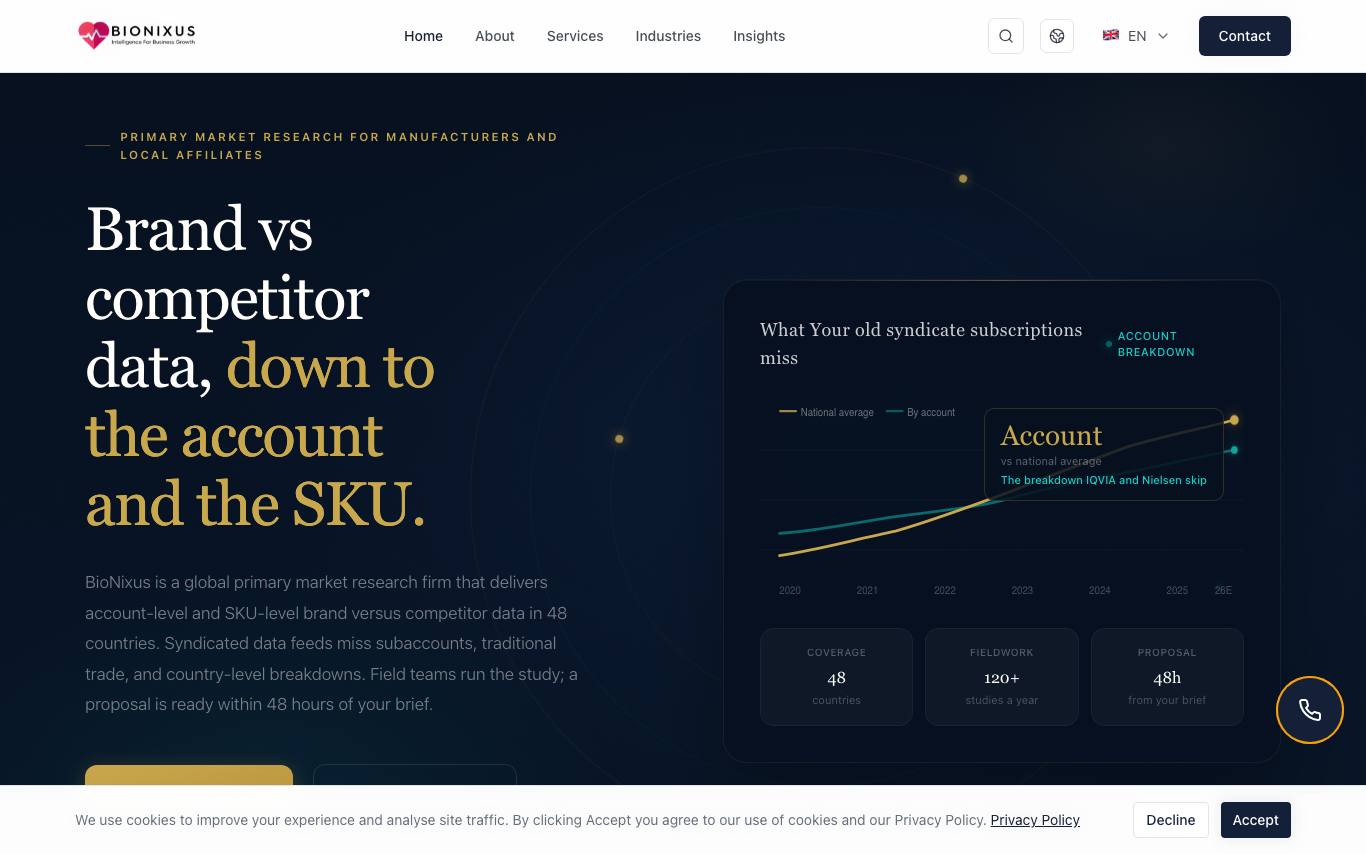
Strongest fitCommercial teams needing granular competitive intelligence to guide brand performance at the hospital or account level.
BioNixus differentiates itself by focusing on granular, account-level performance rather than broad national averages. Their approach is designed to provide actionable intelligence for commercial teams that need to know exactly how their brands are performing in specific hospitals or regions.
Their methodology is particularly useful for launch readiness and competitive landscaping. By providing a clear decision pack that can be taken directly to commercial leadership, they reduce the gap between research and action.
Scorecard: 72.0 out of 100
| Criterion | Weight | Score | Evidence and date |
|---|---|---|---|
| Industry Expertise | 20 | 8/10 | bionixus.com (6 pages reviewed), Oct 2026 |
| Compliance, Certifications and Security | 20 | 7/10 | bionixus.com (6 pages reviewed), Oct 2026 |
| Target Audience Reach | 15 | 7/10 | bionixus.com (6 pages reviewed), Oct 2026 |
| Research Quality | 10 | 8/10 | bionixus.com (6 pages reviewed), Oct 2026 |
| Market Presence | 10 | 2/10 | Google results for this search and company size, Oct 2026 |
| Methodological Breadth | 10 | 9/10 | bionixus.com (6 pages reviewed), Oct 2026 |
| Analytical Capability | 5 | 9/10 | bionixus.com (6 pages reviewed), Oct 2026 |
| Client Service and Speed | 5 | 8/10 | bionixus.com (6 pages reviewed), Oct 2026 |
| Pricing and Feasibility Transparency | 5 | 8/10 | bionixus.com (6 pages reviewed), Oct 2026 |
| Weighted score | 100 | 72.0 |
Core services
- Primary Research: Physician and payer surveys with high statistical rigour.
- Account-level Data: Brand vs competitor analysis down to the account and SKU level.
- Market Access: Support for pricing, reimbursement, and HTA dossiers.
Strengths
- Granular Data: Focuses on account-level and SKU-level performance.
- Decision-Oriented: Outputs are designed for direct use by commercial directors.
- Global Coordination: Capable of managing research across multiple countries including Japan.
Innovation and technology
- Custom Scoping: Proposals scoped to specific commercial questions rather than templates.
- Decision Packs: Delivers comparable, ready-to-use insights for regional roll-ups.
Impact on businesses
- Commercial Edge: Enables precise targeting in competitive drug launches.
- Access Strategy: Informs pricing and reimbursement strategies with payer intelligence.
Why it may fit your brief
BioNixus is ideal for commercial and market access teams that find syndicated data insufficient. It may be less appropriate for projects focused on early-stage patient journey mapping or qualitative exploration of unmet needs.
How HCP and patient verification actually works in Japan
Make sure every respondent is verified through direct license checks and clinical registry validation to maintain the integrity of your research data.
Professional License Validation
For healthcare professionals, providers must verify medical licenses against official Japanese government or medical association registries. This is the baseline for making sure that your respondents are genuine doctors or nurses. Ask the agency to provide a documented methodology for how they cross-reference survey participants with these registries. Be wary of agencies that rely solely on self-reporting or open-market recruitment, as these methods fail to filter out fraudulent accounts that can compromise the validity of your clinical data.
Identity Fingerprinting
Modern agencies should employ digital identity fingerprinting to make sure that the same individual does not participate in multiple surveys or use automated scripts. This involves tracking device IDs, browser configurations, and IP addresses. Request a report on their specific 'anti-fraud' stack. If an agency cannot explain their process for identifying bots or fraudulent completes, you risk receiving data that does not represent the real-world clinical practice of Japanese physicians or the true experiences of patients.
Trap and Attention Questions
Effective questionnaires include embedded trap questions to detect 'speeders' or participants who are not reading the survey content carefully. A professional agency will also monitor completion times and straight-lining patterns. Ask how they flag these respondents and what their policy is for removing them from the final dataset. High-quality agencies will automatically purge these low-quality completes before delivery, making sure you are paying for insights that are both accurate and reliable.
Rolling Re-validation
Healthcare panels in Japan are dynamic, with physicians changing roles or institutions. The most reliable panels undergo rolling re-validation where panellist information is updated and verified on a set schedule. Ask the provider how often they refresh their panel data. A panel that has not been updated in years is likely to contain inactive or inaccurate profiles. Consistent re-validation is a sign of a well-maintained, high-quality infrastructure that protects the ROI of your market research investment.
How to choose the right provider in Japan
Select your research partner based on the specific research question and the depth of local market understanding required for your project.
- Define Research Goals: Clearly distinguish between quantitative tracking and qualitative exploration. Quantitative studies require large, verified panels, while qualitative work requires consultants with deep bicultural expertise.
- Verify Local Compliance: Make sure the agency understands the specific regulatory environment in Japan, particularly PMDA and MHLW guidelines. This is non-negotiable for pharmaceutical and medical device studies.
- Audit Data Quality: Request detailed information on how the provider prevents fraud, including bot detection and identity verification. Do not accept general assurances; ask for their specific quality control protocols.
- Assess Local Depth: Evaluate the agency's track record in the specific therapeutic area you are studying. A firm with deep local expertise will better interpret the nuances of Japanese clinical practice.
- Test Communication: Assess the responsiveness and clarity of the account team during the scoping phase. A partner that communicates clearly and manages expectations early is more likely to handle project hurdles effectively.
Questions to ask before you commission
- What specific methodologies do you use to verify that your physician panellists are currently practicing in Japan?
- How do you handle adverse event reporting for pharmaceutical studies conducted in Japan?
- Can you provide a detailed report on how you detect and remove bot activity or fraudulent completes from your datasets?
- What is your experience in managing studies that require compliance with PMDA or MHLW regulatory requirements?
- How do you make sure that your qualitative reports reflect both the raw data and the cultural context of the Japanese healthcare system?
- What is your process for managing recruitment feasibility for low-incidence medical conditions in Japan?
Common pitfalls to avoid
- Ignoring Panel Quality: Relying on generic, open-internet panels rather than verified medical panels can lead to low-quality data and unreliable strategic insights.
- Underestimating Local Nuance: Assuming that global research templates will work without localization can fail to capture the specific behaviours and preferences of Japanese HCPs.
- Lack of Compliance Checks: Failing to verify that the agency follows local data protection and health-data handling laws can put your firm at significant legal and reputation risk.
- Poor Feasibility Planning: Not asking for a realistic feasibility assessment up front can lead to project delays and failed recruitment when targeting rare diseases or specific physician sub-specialties.
What a feasibility check should include
Conduct a rigorous feasibility check early to avoid mid-project delays and make sure your research goals are achievable within the target timeline.
Targeted Sample Size
Confirm that the provider has a sufficient number of active panellists meeting your precise criteria, such as specific sub-specialties or hospital types, to protect statistical significance.
Incidence Rate Estimation
Ask for a realistic estimate of the incidence rate for your target group, as this directly affects the cost and timeline of your recruitment effort.
Regulatory Hurdles
Check if your study design requires specific approvals or compliance steps that might delay the start of fieldwork, such as ethics committee reviews or specific data handling protocols.
Timeline Realism
Protect the proposed timeline accounts for the time required for high-quality recruitment and data cleaning, rather than just the time for the survey to be live.
Conclusion
Choosing between healthcare market research companies in Japan requires a balanced assessment of technical capacity and local strategic depth. For large-scale quantitative initiatives where volume and speed are essential, providers with massive, verified physician panels offer the most efficient path. Conversely, for projects requiring deep qualitative insights, bicultural consultancy firms that can work through the nuances of Japanese medical communication are often a more effective choice.
Ultimately, your decision should be guided by the specific nature of your business question. Use the scorecard provided to weigh each agency’s strengths against your own priorities, and do not hesitate to ask for evidence of their data quality and regulatory compliance processes. The Japanese healthcare market is complex, but with the right research partner, it offers significant potential for well-informed, evidence-based strategic decisions.
Planning research in Japan? Tell us your audience, markets and timeline, and we will come back with a feasibility check and recommended approach.
Frequently asked questions
How to conduct healthcare market research in Japan?
Conducting research in Japan requires a structured approach: first, define your target audience clearly, whether HCPs, patients, or payers. Second, partner with a local agency or a firm with strong domestic infrastructure to protect compliance with local regulations and cultural nuances. Third, make sure your research instruments are designed for the Japanese context, considering local clinical pathways and communication styles. Finally, use verified panels to make sure the data is representative and reliable, avoiding open-source samples.
What are the best physician panels in Japan?
The best physician panels in Japan are those that are proprietary, verified, and regularly updated. Agencies like Global Vox Populi and M3 Global Research maintain extensive, validated networks of healthcare professionals. When evaluating a panel, prioritize those that perform rolling license checks, maintain strict identity security, and offer granular profiling, as these features make sure the physicians you survey are truly active, registered professionals in their stated specialties.
How does the Japanese pharmaceutical market research environment differ from the West?
The Japanese market differs significantly due to its centralized reimbursement system, unique drug-pricing mechanisms, and the specific role of the PMDA in drug regulation. Additionally, Japanese clinical practice often follows different protocols compared to Western countries. Research must account for these institutional differences, as well as cultural preferences in communication, where indirect feedback and consensus-based decision-making are more prevalent among healthcare professionals than in some Western contexts.
Are there specific regulations for medical market research in Japan?
Yes, research in Japan must comply with strict data protection laws, including the Act on the Protection of Personal Information (APPI). Also, pharmaceutical research is often guided by regulations from the Ministry of Health, Labour and Welfare (MHLW) and the PMDA. It is essential that your research partner follows these local guidelines, as well as international standards like the ICC/ESOMAR Code, to make sure all patient data is handled ethically and legally.
How to find reliable healthcare market research agencies in Japan?
Find reliable agencies by vetting them against strict criteria: look for ISO 20252, ISO 9001, and ISO/IEC 27001 certifications. Ask for proof of their recruitment and verification processes, such as how they validate medical licenses. Prioritize agencies that offer transparency on feasibility and incidence rates. Reading case studies or looking for firms with a long-standing local presence can also provide confidence in their ability to work through the complex Japanese healthcare environment.
What is the role of the Japan Medical Marketing Research Group?
The Japan Medical Marketing Research Group (JMMRG) is an industry organization that focuses on the standards and practices of healthcare market research within Japan. It serves as a forum for professionals to discuss market trends, regulatory updates, and the development of best practices. Engaging with or selecting agencies that participate in such groups can be an indicator of their commitment to professional standards, ethical research conduct, and staying updated on the evolving Japanese healthcare environment.
Can international firms conduct healthcare research in Japan directly?
While international firms can technically conduct research, it is highly challenging without local support. The language barrier, the need for deep cultural understanding, and the complexities of the Japanese healthcare system make partnering with a local agency or an international firm with established Japanese infrastructure almost essential. Without a local partner, you risk misinterpreting data, failing to reach the right audience, and violating local regulations, which can severely impact the quality and validity of your research outcomes.
What are the essential steps for validating Japanese HCPs?
Validating Japanese HCPs requires a multi-step process: verify their medical license or registration numbers through official government databases, cross-reference their institution with public records, and conduct periodic re-validation to make sure their status remains current. Agencies should also use identity fingerprinting and device checks to confirm that the person taking the survey is the professional they claim to be. This rigorous verification is the only way to make sure the clinical data you collect is authentic.