Best UX Research Agencies
Compare leading ux research agencies in 2026 to improve your digital product strategy with verified, high-quality human insights and global panel access.
Quick answer
For deep, evidence-based UX strategy, AnswerLab is a strong choice; for rapid agile product iteration, UX Studio fits well; for large-scale global benchmarking and standardized metrics, Ipsos or Kantar are preferred; for foundational research and methodology, Global Vox Populi offers extensive proprietary panel access worldwide.
Selecting the right partner from the many available ux research agencies requires balancing the need for deep, qualitative human insight against the demand for quantitative, statistically significant data. In a worldwide market defined by rapid digital adoption and shifting user expectations, decision-makers must distinguish between firms that provide tactical usability testing and those that offer long-term product strategy.
This assessment examines the capabilities of leading ux research agencies, focusing on how their methodological rigor, panel access, and analytical frameworks impact high-stakes product decisions. The objective is to provide a clear, evidence-led guide for insights directors and product leaders working through this complex field in 2026.
Best UX Research Agencies: rankings and scores
Exhibit 1: Ranking and weighted score (out of 100)
| Rank | Provider | Best for | Weighted score |
|---|---|---|---|
| 1 | Kantar | Large-scale brand and consumer insights | 86.0 |
| 2 | Global Vox Populi | Large-scale, multi-market verified research | 85.5 |
| 3 | Ipsos | ISO-certified global UX benchmarking | 84.5 |
| 4 | AnswerLab | Longitudinal in-home product testing | 82.0 |
| 5 | Nielsen Norman Group | UX research-based training and consulting | 76.0 |
| 6 | UX Studio | Agile B2B SaaS product development | 73.0 |
| 7 | Blink UX | Complex product network integration | 70.5 |
Exhibit 2: Provider comparison
| Provider | Audience types | Verification method | Certifications | Pricing model | Panel size and source | Minimum project |
|---|---|---|---|---|---|---|
| Kantar | Global consumers, brand buyers, digital audiences | Proprietary AI-enabled panel platform | Not stated on pages reviewed | Per complete | Not published | Not published |
| Global Vox Populi | Consumers, B2B, IT, healthcare, financial professionals | Identity, license, company records, and fingerprinting | ISO 9001, ISO 20252, ISO/IEC 27001, HIPAA compliant; follows ESOMAR, Insights Association and BHBIA guidelines | Project quote | 29,093,467 B2C consumers; 4,912,644 B2B professionals; 2,738,904 healthcare professionals (worldwide; Global Vox Populi panel records, Oct 2026) | Not published |
| Ipsos | Global consumers, patients, citizens, employees | Proprietary panel authentication | Not stated on pages reviewed | Project quote | Not published | Not published |
| AnswerLab | General consumers, utility customers, retail shoppers | Not published | Not stated on pages reviewed | Project quote | Not published | Not published |
| Nielsen Norman Group | UX professionals, product managers, designers | Not published | Not stated on pages reviewed | Not published | Not published | Not published |
| UX Studio | B2B software users, product managers, engineers | Not published | Not stated on pages reviewed | Not published | Not published | Not published |
| Blink UX | Enterprise software users, digital product teams | Not published | Not stated on pages reviewed | Not published | Not published | Not published |
Exhibit 3: Capability matrix
| Provider | Quantitative | Qualitative | Own panels / sample | Healthcare | B2B | Multi-country |
|---|---|---|---|---|---|---|
| Kantar | ● | ● | ● | – | – | ● |
| Global Vox Populi | ● | ● | ● | ● | ● | ● |
| Ipsos | ● | ● | – | ● | – | ● |
| AnswerLab | ● | ● | – | – | – | – |
| Nielsen Norman Group | ● | ● | – | – | – | ● |
| UX Studio | – | ● | – | ● | ● | – |
| Blink UX | – | – | – | – | – | – |
Table data from each provider’s own website and public sources, reviewed October 2026. “Not published” means the provider does not state it publicly. ● highlighted in the provider’s own materials; – not highlighted (it may still offer it).
How we scored these providers
Rigorous evaluation of ux research agencies requires assessing their methodological depth, sample integrity, and the ability to translate observational data into actionable product roadmaps.
| Criterion | Weight | What it means here |
|---|---|---|
| Research Quality | 20 | Research quality measures the methodological rigor applied to study design, participant selection, and analysis. In worldwide, good quality means the ability to produce consistent results across diverse cultural contexts and device platforms. High-performing agencies document their processes clearly and focus on mitigating bias to make sure findings are reliable and reproducible for strategic planning. |
| Methodological Breadth | 15 | This criterion evaluates the range of tools a firm offers, from qualitative ethnography to large-scale quantitative surveys. A strong provider in worldwide should balance traditional in-person methods with digital-first approaches, such as remote usability testing and mobile diary studies, to capture user behavior wherever they interact with your digital products. |
| Fieldwork Capability | 15 | Fieldwork capability assesses the logistics of executing research, including recruitment speed and the quality of moderators. Effective firms manage fieldwork by maintaining tight control over local recruitment partners or their own internal teams, making sure that the participants match the target profile and that the data collected is accurate and representative. |
| Sample Quality and Verification | 10 | Sample quality focuses on the authenticity of participants and the processes used to verify their identity. In worldwide, this involves rigorous checks against professional licenses or demographic records. Good practice requires using proprietary, actively managed panels rather than relying on open-exchange samples, which are frequently susceptible to bot activity and fraudulent responses. |
| Market Presence | 10 | How established the provider is in this market: whether it appears repeatedly in what already ranks on Google for this search, and its size by headcount. Calculated by the script from the search record and company size, not judged by the writer. |
| Compliance, Certifications and Security | 10 | This evaluates adherence to global data protection laws like GDPR, alongside ISO 20252 and ISO/IEC 27001 standards. Providers must demonstrate that they protect sensitive user information and maintain ethical research practices. Compliance is non-negotiable for large enterprises, as it guards against legal risks and makes sure that participant consent is handled with integrity. |
| Analytical Capability | 10 | Analytical capability is the ability to derive meaning from complex data sets and present it as a clear product strategy. The best agencies do not simply report findings; they synthesize qualitative observations and quantitative metrics into actionable recommendations, helping product teams understand not just what happened, but why, and how to improve. |
| Client Service and Speed | 5 | This measures the responsiveness of the agency and its ability to turn around projects within tight product development cycles. Good client service includes proactive communication, clear reporting of potential delays, and a collaborative approach to solving unforeseen problems during the research process, making sure that insights arrive when the product team needs them. |
| Pricing and Feasibility Transparency | 5 | This criterion checks whether a provider offers clear, upfront information about costs and the reality of reaching a target audience. In worldwide, agencies that provide honest assessments of incidence rates and project timelines are more valuable than those that overpromise, as they allow for better budget management and more predictable product development outcomes. |
Why these weights. For full-service work, the quality of the research design decides whether the answer can be trusted, so it leads (20). Methods and fieldwork (15 each) decide whether that design can be executed in this market. Sample quality, compliance and analysis (10 each) separate good partners from adequate ones; service and pricing transparency (5 each) are tie-breakers. Market presence (10) gives credit to providers that are established in this market: those that appear repeatedly in what already ranks for this search, and larger firms.
Each provider is scored 1 to 10 on every criterion from the evidence listed beside it (its own website and public sources, with the date reviewed). Weighted score = sum of score × weight ÷ 10, out of 100. Read the full scoring methodology. Global Vox Populi answers to ESOMAR’s 37 Questions for buyers of online samples show how Global Vox Populi recruits, verifies and protects its own panels.
Provider profiles: UX research agencies worldwide
Kantar: best for large-scale brand and consumer insights
Strongest fitGlobal organizations needing large-scale, automated consumer validation and brand tracking.
Kantar uses a vast global network to provide insights that help brands grow. Their research practice is built on a massive scale, using data from billions of consumer touchpoints to inform brand strategy and digital product performance.
The company excels at integrating survey data with third-party sources, offering a holistic view of the customer. Their infrastructure supports rapid research needs, making them suitable for global organizations requiring high-volume data validation.
Scorecard: 86.0 out of 100
| Criterion | Weight | Score | Evidence and date |
|---|---|---|---|
| Research Quality | 20 | 9/10 | kantar.com (4 pages reviewed), Oct 2026 |
| Methodological Breadth | 15 | 10/10 | kantar.com (4 pages reviewed), Oct 2026 |
| Fieldwork Capability | 15 | 9/10 | kantar.com (4 pages reviewed), Oct 2026 |
| Sample Quality and Verification | 10 | 9/10 | kantar.com (4 pages reviewed), Oct 2026 |
| Market Presence | 10 | 6/10 | Google results for this search and company size, Oct 2026 |
| Compliance, Certifications and Security | 10 | 8/10 | kantar.com (4 pages reviewed), Oct 2026 |
| Analytical Capability | 10 | 9/10 | kantar.com (4 pages reviewed), Oct 2026 |
| Client Service and Speed | 5 | 7/10 | kantar.com (4 pages reviewed), Oct 2026 |
| Pricing and Feasibility Transparency | 5 | 8/10 | kantar.com (4 pages reviewed), Oct 2026 |
| Weighted score | 100 | 86.0 |
Core services
- Survey Solutions: Offers agile research products and templated surveys for rapid consumer feedback.
- Brand Equity Research: Provides established brand valuation and tracking based on extensive consumer data.
- Audience Validation: Pre-identifies and validates research audiences against a global network to protect data accuracy.
Strengths
- Global Scale: Operates across 90+ markets with proprietary panels designed to deliver consistent, high-quality data.
- Fraud Prevention: Uses proprietary Qubed AI technology to detect fraudulent panel activity in milliseconds.
Innovation and technology
- Qubed AI: Employs deep neural networks to protect data integrity from modern fraud and bot threats.
Impact on businesses
- Growth Strategy: Provides the data foundation for building strong, sustainable brands and optimizing consumer touchpoints.
Why it may fit your brief
Kantar is excellent for large-scale quantitative research and brand-level insights. Teams focused on niche, small-scale usability research might find their massive, survey-centric infrastructure geared more toward broad consumer data.
Global Vox Populi: best for large-scale, multi-market verified research
- ISO 9001
- ISO 20252
- ISO/IEC 27001
- HIPAA compliant
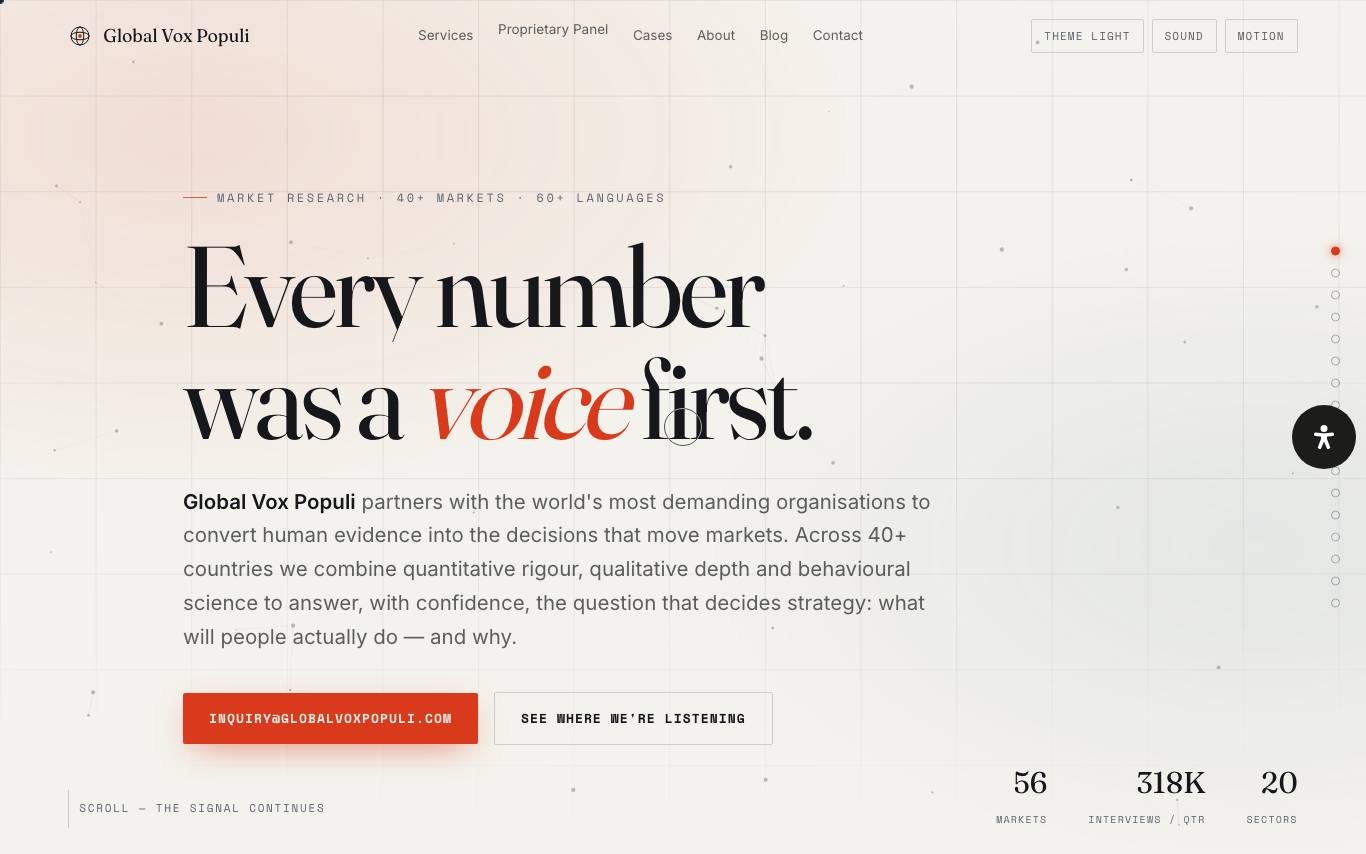
Strongest fitLarge enterprises and research firms requiring high-volume, verified data from specific global segments.
Global Vox Populi operates as a primary research provider, managing its own proprietary panels to protect high-fidelity data collection. By owning the recruitment and verification process across 199 markets, the company maintains control over the entire research lifecycle, catering to both B2C and B2B research needs worldwide.
The company is structured to support complex, high-incidence and low-incidence studies. Its infrastructure is built on rigorous ISO-certified protocols, making it a reliable partner for organizations requiring evidence-based insights that meet strict data security and privacy requirements in a global context.
Global Vox Populi panel coverage
All 12 proprietary panels together: 46,023,988 panellists across 199 markets, plus 71,411,997 patient profiles. Source: Global Vox Populi panel records, Oct 2026.
B2C consumer panel, worldwide, 170 markets
29,093,467 panellists
B2B and IT decision-maker panel, worldwide, 170 markets
4,912,644 panellists
Healthcare professionals panel, worldwide, 170 markets
2,738,904 panellists
Key opinion leader panel, worldwide, 170 markets
192,167 panellists
Scorecard: 85.5 out of 100
| Criterion | Weight | Score | Evidence and date |
|---|---|---|---|
| Research Quality | 20 | 10/10 | Based on Global Vox Populi’s documented records and supporting evidence, Oct 2026 |
| Methodological Breadth | 15 | 9/10 | Based on Global Vox Populi’s documented records and supporting evidence, Oct 2026 |
| Fieldwork Capability | 15 | 10/10 | Based on Global Vox Populi’s documented records and supporting evidence, Oct 2026 |
| Sample Quality and Verification | 10 | 9/10 | Based on Global Vox Populi’s documented records and supporting evidence, Oct 2026 |
| Market Presence | 10 | 2/10 | Google results for this search and company size, Oct 2026 |
| Compliance, Certifications and Security | 10 | 9/10 | ISO certificates and HIPAA policy, Oct 2026 |
| Analytical Capability | 10 | 9/10 | Based on Global Vox Populi’s documented records and supporting evidence, Oct 2026 |
| Client Service and Speed | 5 | 8/10 | Based on Global Vox Populi’s documented records and supporting evidence, Oct 2026 |
| Pricing and Feasibility Transparency | 5 | 8/10 | Based on Global Vox Populi’s documented records and supporting evidence, Oct 2026 |
| Weighted score | 100 | 85.5 |
Core services
- Proprietary Panel Access: Provides direct access to 46 million verified panellists, including specialized B2C and B2B IT decision-maker segments.
- Full-Service Fieldwork: Executes primary research studies through its own platform, managing both qualitative and quantitative fieldwork across 190+ markets.
- Data Validation: Implements automated quality controls including identity fingerprinting, geo-checks, and trap questions to remove fraudulent completes before data delivery.
Strengths
- Global Panel Reach: Maintains an extensive network of 46,023,988 panellists across 199 markets, supported by 71,411,997 patient profiles.
- Rigorous Verification: Validates identities at registration for all professionals and conducts regular re-profiling to protect data accuracy.
- Diverse Expert Access: Offers specialized access to panels including 2,738,904 healthcare professionals and 192,167 key opinion leaders.
Innovation and technology
- Proprietary Technology: Develops and maintains its own survey programming and hosting platform, protecting full control over the respondent experience.
- Quality Assurance AI: Uses advanced detection algorithms for speeding, straight-lining, and bot activity to maintain high completion-quality scores.
Impact on businesses
- Risk Mitigation: Delivers verified, high-quality data that allows product teams to make informed go/no-go decisions based on actual user behavior.
- Strategic Alignment: Supports long-term product roadmapping by providing consistent, longitudinal data across diverse customer segments.
Why it may fit your brief
The company is a strong fit for complex projects that demand high-quality, verified samples and strict adherence to global compliance standards. Smaller, hyper-localized design-only projects may find the scale of these services more extensive than their specific needs require.
Ipsos: best for ISO-certified global UX benchmarking
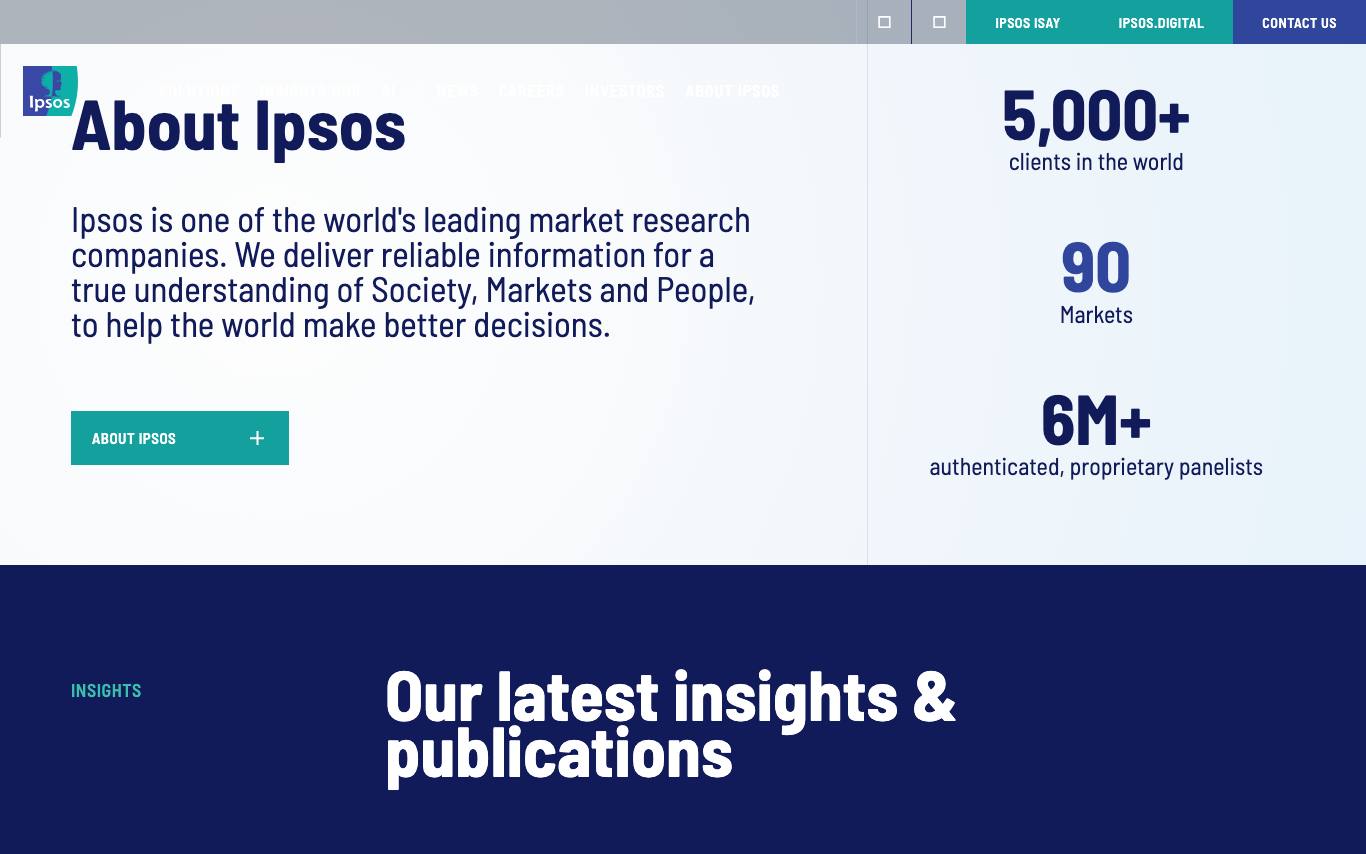
Strongest fitGlobal enterprises requiring standardized UX performance metrics across multiple international markets.
Ipsos combines global research infrastructure with deep expertise in experience measurement. Their UX practice is supported by ISO-certified processes, protecting reliability and accuracy when measuring user interfaces across diverse international markets.
Their approach integrates qualitative depth, such as ethnography, with quantitative benchmarking, allowing clients to track UX performance alongside broader market trends. They are well-positioned for enterprises that require standardized metrics across multiple regions.
Scorecard: 84.5 out of 100
| Criterion | Weight | Score | Evidence and date |
|---|---|---|---|
| Research Quality | 20 | 9/10 | ipsos.com (4 pages reviewed), Oct 2026 |
| Methodological Breadth | 15 | 9/10 | ipsos.com (4 pages reviewed), Oct 2026 |
| Fieldwork Capability | 15 | 9/10 | ipsos.com (4 pages reviewed), Oct 2026 |
| Sample Quality and Verification | 10 | 8/10 | ipsos.com (4 pages reviewed), Oct 2026 |
| Market Presence | 10 | 6/10 | Google results for this search and company size, Oct 2026 |
| Compliance, Certifications and Security | 10 | 9/10 | ipsos.com (4 pages reviewed), Oct 2026 |
| Analytical Capability | 10 | 9/10 | ipsos.com (4 pages reviewed), Oct 2026 |
| Client Service and Speed | 5 | 7/10 | ipsos.com (4 pages reviewed), Oct 2026 |
| Pricing and Feasibility Transparency | 5 | 8/10 | ipsos.com (4 pages reviewed), Oct 2026 |
| Weighted score | 100 | 84.5 |
Core services
- UX Benchmarking: Uses proprietary UX Score tools to measure and track digital experience performance consistently.
- Qualitative Research: Conducts in-depth qualitative studies, including ethnography and online communities, to understand user behavior.
- Market Understanding: Provides broad market strategy insights that connect UX performance to brand health and societal trends.
Strengths
- Global Infrastructure: Maintains a solid research network in 90 countries, enabling consistent multi-market UX studies.
- Standardized Metrics: Offers proprietary UX benchmarking tools that allow for reliable performance tracking over time.
Innovation and technology
- AI-Driven Insights: Applies AI to survey data and social media sentiment to deliver faster, more relevant findings.
Impact on businesses
- Confidence in Decisions: Helps global brands make bolder, faster product decisions grounded in standardized, reliable data.
Why it may fit your brief
Ipsos is well-suited for organizations that need consistent, scalable metrics for their digital interfaces. For smaller, one-off research projects, their large-scale corporate structure might be more than the project requires.
AnswerLab: best for longitudinal in-home product testing
Strongest fitAmbitious product teams needing to de-risk investment in new technology or product categories.
AnswerLab specializes in translating rigorous research into experience strategy. With a team of 200+ researchers, they focus on identifying human truths that influence product adoption and long-term value, helping brands work through complex digital transformations.
The firm is known for its ability to handle high-stakes, longitudinal studies, often working with global brands to de-risk investments in new technology categories. Their approach combines deep qualitative discovery with quantitative validation to create actionable design roadmaps.
Scorecard: 82.0 out of 100
| Criterion | Weight | Score | Evidence and date |
|---|---|---|---|
| Research Quality | 20 | 9/10 | answerlab.com (6 pages reviewed), Oct 2026 |
| Methodological Breadth | 15 | 8/10 | answerlab.com (6 pages reviewed), Oct 2026 |
| Fieldwork Capability | 15 | 9/10 | answerlab.com (6 pages reviewed), Oct 2026 |
| Sample Quality and Verification | 10 | 7/10 | answerlab.com (6 pages reviewed), Oct 2026 |
| Market Presence | 10 | 7/10 | Google results for this search and company size, Oct 2026 |
| Compliance, Certifications and Security | 10 | 8/10 | answerlab.com (6 pages reviewed), Oct 2026 |
| Analytical Capability | 10 | 9/10 | answerlab.com (6 pages reviewed), Oct 2026 |
| Client Service and Speed | 5 | 8/10 | answerlab.com (6 pages reviewed), Oct 2026 |
| Pricing and Feasibility Transparency | 5 | 7/10 | answerlab.com (6 pages reviewed), Oct 2026 |
| Weighted score | 100 | 82.0 |
Core services
- Experience Strategy: Translates research findings into validated roadmaps and design direction to drive business outcomes.
- Behavioral Research: Conducts in-home longitudinal studies and contextual inquiry to understand how users think and behave in their environment.
- Usability Testing: Performs rapid concept testing and usability evaluations to refine digital interactions before full-scale launch.
Strengths
- Longitudinal Research: Designs multi-phase studies that measure how user behavior and product value durability evolve over time.
- Contextual Inquiry: Executes research in active environments, such as in-store shopping trips, to capture real-world user interactions.
Innovation and technology
- AI-Enabled Methods: Integrates AI workflow analysis to understand how people interact with emerging technology in their daily tasks.
Impact on businesses
- Risk Reduction: Provides evidence to support go/no-go decisions on significant platform investments.
Why it may fit your brief
AnswerLab is ideal for companies that need deep behavioral understanding and strategy, not just a list of usability bugs. Firms looking for purely tactical, low-cost UI audits might find their strategic approach more intensive than necessary.
Nielsen Norman Group: best for UX research-based training and consulting

Strongest fitOrganizations looking to build internal UX maturity or seeking expert validation of their design standards.
Nielsen Norman Group is recognized for its foundational work in UX, focusing on scientific, evidence-based methodology. They offer a combination of consulting services and professional training, helping organizations establish UX maturity and design standards.
Their work is rooted in over 28 years of research, providing a benchmark for UX practices. Organizations look to them for guidance on complex interface challenges and for educating internal teams on proven UX principles.
Scorecard: 76.0 out of 100
| Criterion | Weight | Score | Evidence and date |
|---|---|---|---|
| Research Quality | 20 | 10/10 | nngroup.com (6 pages reviewed), Oct 2026 |
| Methodological Breadth | 15 | 7/10 | nngroup.com (6 pages reviewed), Oct 2026 |
| Fieldwork Capability | 15 | 7/10 | nngroup.com (6 pages reviewed), Oct 2026 |
| Sample Quality and Verification | 10 | 7/10 | nngroup.com (6 pages reviewed), Oct 2026 |
| Market Presence | 10 | 6/10 | Google results for this search and company size, Oct 2026 |
| Compliance, Certifications and Security | 10 | 7/10 | nngroup.com (6 pages reviewed), Oct 2026 |
| Analytical Capability | 10 | 9/10 | nngroup.com (6 pages reviewed), Oct 2026 |
| Client Service and Speed | 5 | 6/10 | nngroup.com (6 pages reviewed), Oct 2026 |
| Pricing and Feasibility Transparency | 5 | 6/10 | nngroup.com (6 pages reviewed), Oct 2026 |
| Weighted score | 100 | 76.0 |
Core services
- UX Consulting: Provides expert-led research, design reviews, and strategic guidance to improve interface usability.
- Professional Training: Delivers live online and in-person training courses to build in-house UX expertise.
- UX Certification: Offers an exam-based credential that validates a professional's understanding of UX research and design best practices.
Strengths
- Evidence-Based Guidance: Grounds all consulting and training in extensive, long-term research on human-computer interaction.
- Industry Standards: Sets many of the foundational UX heuristics and methods used globally by practitioners today.
Innovation and technology
- Methodological Development: Continually updates and publishes research on new challenges, including AI-driven design and agentic systems.
Impact on businesses
- Maturity Elevation: Helps organizations assess and improve their UX maturity stage to achieve better business outcomes.
Why it may fit your brief
NN/g is best for companies prioritizing education and methodology. Those needing a high-volume, ongoing fieldwork partner for daily usability testing might find their consultative and training focus a different value proposition.
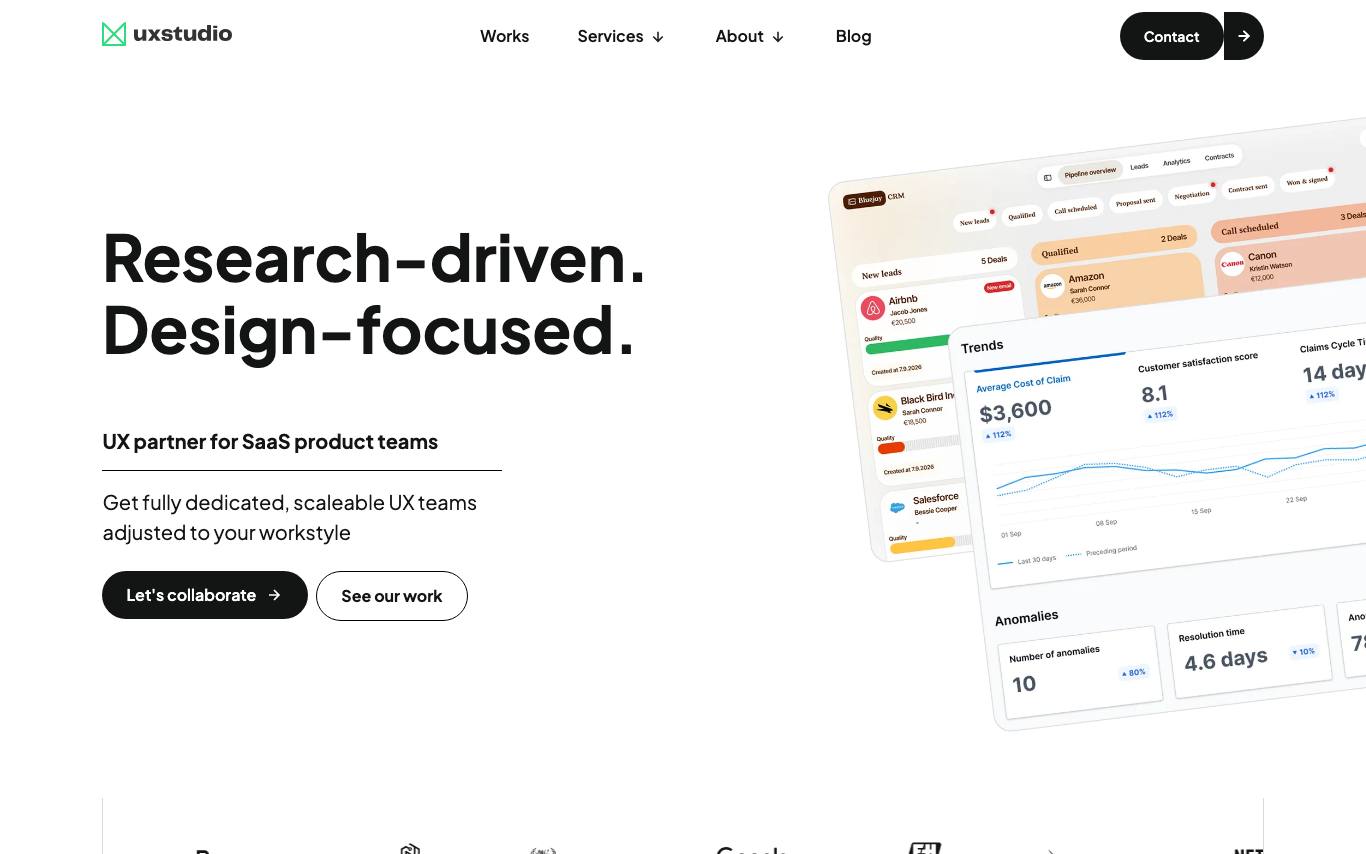
UX Studio: best for agile B2B SaaS product development
Strongest fitB2B SaaS teams requiring additional design and research capacity to meet tight release deadlines.
UX Studio supports product teams by integrating research and design into iterative, fast-paced cycles. Their approach is particularly suited for SaaS companies that need to ship updates continuously while maintaining a consistent user experience.
They emphasize knowledge sharing, often coaching internal teams on design thinking and user empathy. Their collaborative model allows them to function as an extension of the client’s internal product team.
Scorecard: 73.0 out of 100
| Criterion | Weight | Score | Evidence and date |
|---|---|---|---|
| Research Quality | 20 | 8/10 | uxstudioteam.com (6 pages reviewed), Oct 2026 |
| Methodological Breadth | 15 | 7/10 | uxstudioteam.com (6 pages reviewed), Oct 2026 |
| Fieldwork Capability | 15 | 8/10 | uxstudioteam.com (6 pages reviewed), Oct 2026 |
| Sample Quality and Verification | 10 | 6/10 | uxstudioteam.com (6 pages reviewed), Oct 2026 |
| Market Presence | 10 | 6/10 | Google results for this search and company size, Oct 2026 |
| Compliance, Certifications and Security | 10 | 6/10 | uxstudioteam.com (6 pages reviewed), Oct 2026 |
| Analytical Capability | 10 | 8/10 | uxstudioteam.com (6 pages reviewed), Oct 2026 |
| Client Service and Speed | 5 | 9/10 | uxstudioteam.com (6 pages reviewed), Oct 2026 |
| Pricing and Feasibility Transparency | 5 | 8/10 | uxstudioteam.com (6 pages reviewed), Oct 2026 |
| Weighted score | 100 | 73.0 |
Core services
- Agile Research Sprints: Delivers fast, iterative user insights to support continuous product shipping cycles.
- Product Strategy: Provides proactive advice on design and user experience to solve complex B2B workflow problems.
- UX/UI Design: Covers the entire design process from information architecture and wireframing to final prototype development.
Strengths
- SaaS Expertise: Deep experience in B2B SaaS environments, understanding the nuances of technical user journeys.
- Team Coaching: Upscales the internal team's UX capabilities through continuous knowledge sharing during projects.
Innovation and technology
- Iterative Design Systems: Builds design systems that support consistency as products grow and scale.
Impact on businesses
- Product Velocity: Enables teams to make faster, user-centric decisions through collaborative design and research.
Why it may fit your brief
This agency is ideal for teams needing flexible, hands-on support for ongoing product development. Those requiring large-scale, standalone research studies without design components might find their integrated approach less focused.
Blink UX: best for complex product network integration
Strongest fitProduct organizations dealing with complex, multi-platform digital software environments.
Blink UX focuses on large-scale technology integrations, helping organizations work through complex product networks. Their practice is built around the intersection of research and design, making sure that digital products are informed by actual user data.
By collaborating closely with product teams, they help bridge the gap between user needs and technical constraints. Their methodology prioritizes evidence-based design to improve user outcomes in intricate digital environments.
Scorecard: 70.5 out of 100
| Criterion | Weight | Score | Evidence and date |
|---|---|---|---|
| Research Quality | 20 | 8/10 | Search results and industry sources, Oct 2026 |
| Methodological Breadth | 15 | 7/10 | Search results and industry sources, Oct 2026 |
| Fieldwork Capability | 15 | 7/10 | Search results and industry sources, Oct 2026 |
| Sample Quality and Verification | 10 | 6/10 | Search results and industry sources, Oct 2026 |
| Market Presence | 10 | 7/10 | Google results for this search and company size, Oct 2026 |
| Compliance, Certifications and Security | 10 | 6/10 | Search results and industry sources, Oct 2026 |
| Analytical Capability | 10 | 8/10 | Search results and industry sources, Oct 2026 |
| Client Service and Speed | 5 | 7/10 | Search results and industry sources, Oct 2026 |
| Pricing and Feasibility Transparency | 5 | 6/10 | Search results and industry sources, Oct 2026 |
| Weighted score | 100 | 70.5 |
Core services
- Generative Research: Explores user needs and behaviors at the start of product development to inform foundational strategy.
- Evaluative Studies: Tests existing or prototype interfaces to identify friction points and validate design decisions.
Strengths
- Technology Integration: Specializes in designing for complex digital networks where multiple technologies must work together.
Innovation and technology
- Evidence-Driven Design: Uses rigorous research data to directly inform and validate UI/UX design choices.
Impact on businesses
- Product Optimization: Helps organizations build more effective digital products by grounding design in user feedback.
Why it may fit your brief
Blink UX fits well for teams needing both research and design execution in complex software settings. Organizations seeking a pure-play research agency without design intervention may prefer other options.
How respondent verification actually works
Respondent integrity is maintained through multi-layered verification processes including identity authentication, device fingerprinting, and behavioral analysis.
Identity and Professional Verification
For professional and healthcare segments, agencies must verify credentials against official licenses or company records. In worldwide, this prevents unqualified individuals from participating in research intended for specialized experts. Always request documentation of these verification procedures, as relying on open-market samples often leads to compromised data where respondents fake their expertise to qualify for incentives.
Advanced Fraud Detection
Modern agencies use device fingerprinting and geo-location checks to make sure that each participant is unique and located in the expected region. This prevents duplicate responses and blocks known VPNs or botnets. If a provider cannot explain how they detect automated software or 'professional respondents' who participate in surveys for profit rather than opinion, their data is likely unreliable.
Behavioral Quality Controls
Quality control should include trap questions that detect inattentive respondents, as well as analytics to identify straight-lining or unnaturally fast completion times. A high-quality agency will automatically flag or remove these entries before the final report is compiled. You should ask for a summary of their quality-scoring methodology to make sure that every participant in your dataset is providing thoughtful, authentic feedback.
Consent and Privacy Compliance
Verification also extends to making sure that all participants have provided granular, revocable consent in line with GDPR and local data protection laws. This protects your brand from legal liability. Protect the agency uses double opt-in procedures and maintains clear records of consent, as this is a fundamental requirement for ethical research in any global market.
How to choose the right provider worldwide
The selection process hinges on aligning the agency's core methodology with your specific product objectives and the need for global scale.
- Assess research focus: Determine if your project needs foundational generative research to identify user problems or evaluative usability testing to fix specific interface issues. Choose a partner whose expertise matches the current phase of your product.
- Verify sample source: Ask how the agency recruits and verifies participants. Prefer firms that own their proprietary panels rather than those using open exchanges, as this protects higher data reliability.
- Check geographic reach: If your project spans multiple countries, make sure the agency has established fieldwork infrastructure or local partners in those specific markets. This prevents cultural nuances from being lost in translation.
- Evaluate analytical depth: Review sample reports to see if the agency provides strategic recommendations or merely presents raw data. You need a partner that can synthesize findings into clear product improvements.
- Review compliance standards: Confirm that the provider meets your organization's security and privacy standards. In worldwide, ISO certifications and GDPR compliance are essential to mitigate legal risk.
Questions to ask before you commission
- What specific verification processes do you use to protect the authenticity of your research participants?
- Can you describe your experience with projects involving my specific user segment or industry in the markets where we operate?
- How do you handle data quality and bot detection during the fieldwork phase?
- What is your typical approach to synthesizing qualitative observations into quantitative, actionable product recommendations?
- How do you protect consistency in research methodology when conducting multi-market studies?
- What is your policy on transparency regarding feasibility and incidence rates before a project begins?
Common pitfalls to avoid
- Ignoring sample provenance: Relying on low-cost, open-market samples often leads to fraudulent data, which can result in flawed product decisions that prove costly to fix later.
- Overlooking local context: Applying a one-size-fits-all research model across different cultures without local adjustment leads to findings that fail to capture regional behavioral nuances.
- Confusing design with research: Hiring a design-heavy firm when you need rigorous, evidence-based research can result in beautiful interfaces that fail to address core user problems.
- Lack of clear methodology: Failing to demand a detailed research design up front often leads to projects that drift, missing the objectives and wasting budget.
What a feasibility check should include
A professional feasibility check must account for audience incidence, recruitment timelines, and regional availability to set realistic expectations.
Incidence rate analysis
A good feasibility check assesses how hard it is to find your specific users. If the incidence rate is low, the agency should be transparent about the impact on recruitment timelines and costs.
Regional availability
The provider must confirm that they have active, verified participants in all your target markets. Never assume global reach implies local depth without checking specific panel sizes.
Timeline realism
Make sure the agency provides a breakdown of time required for recruitment, fieldwork, and analysis. Beware of providers that promise unrealistic turnaround times, as this often compromises research quality.
Capacity planning
The agency should explicitly state their current capacity to handle your project volume. This prevents delays caused by over-committed teams during peak research periods.
Conclusion
Choosing between ux research agencies is a strategic decision that directly influences the success of your digital products. For deep, longitudinal research or complex product strategy, specialized firms like AnswerLab or UX Studio provide the necessary behavioral focus. If your requirement is for large-scale, standardized benchmarking across many countries, global research leaders like Ipsos or Kantar offer the required infrastructure and data security.
For projects demanding high-fidelity, verified samples and primary research execution, Global Vox Populi provides the proprietary panel depth necessary for precision. Use the provided scorecard to evaluate each firm against your specific project goals, making sure that your final choice balances the need for methodological rigor, sample integrity, and the ability to turn research into actionable, long-term product outcomes.
Planning research worldwide? Tell us your audience, markets and timeline, and we will come back with a feasibility check and recommended approach.
Frequently asked questions
How to choose a UX research agency?
Choose an agency by matching their specific expertise to your product lifecycle stage. Look for firms that own their respondent panels to protect data quality, and prioritize those that demonstrate a clear, documented methodology for synthesis rather than just data collection.
What is the difference between a UX research firm and a UX consultancy?
A UX research firm typically focuses on the collection and analysis of user data, providing actionable insights. A UX consultancy often has a broader mandate, incorporating design, strategy, and implementation, acting as a partner to build or redesign products based on the research.
How much does a UX research project cost?
Costs vary significantly based on project scope, audience difficulty, and the depth of analysis required. Most agencies provide project-based quotes rather than fixed pricing, as factors like panel recruitment, moderator time, and data synthesis time vary widely by brief.
When should you hire a UX research agency?
Hire an agency when you need to remove bias from your product decisions, when your internal team lacks the capacity for large-scale fieldwork, or when you need access to specialized, verified user segments that are not available through your own channels.
What methods do UX research agencies use?
Agencies use a mix of qualitative and quantitative methods, including in-depth interviews, usability testing, ethnography, and large-scale surveys. Advanced agencies also use behavioral science frameworks and AI-assisted analysis to extract deeper meaning from user data.
How do you evaluate the quality of a UX research agency?
Evaluate quality by checking their adherence to industry research standards like ISO 20252, their transparency regarding panel verification, and their ability to provide concrete examples of how their research led to specific, measurable product improvements for previous clients.
Does a UX research agency need to be in my country?
Not necessarily. Many top-tier agencies operate globally and conduct research in multiple markets. The key is making sure they have local recruitment capabilities and understand the cultural nuances of your target regions to make sure the research remains relevant and accurate.
How do I protect data security during UX research?
Make sure your chosen agency is compliant with relevant data protection laws like GDPR or HIPAA, and ask for their ISO/IEC 27001 certification. They should provide clear documentation on how they store, anonymize, and protect respondent data throughout the research lifecycle.